On this page
- Awaab's Law Compliance Checklist: Response Times Every Landlord Must Know
- What Is Awaab's Law?
- The Mandatory Response Timeframes
- Emergency Hazards — 24 Hours
- Significant Damp and Mould — 14 Working Days Total
- Other Significant Hazards (From October 2026)
- The Compliance Checklist
- Immediate Setup (Do Now)
- When a Hazard Is Reported
- Record-Keeping Requirements
- If You Can't Meet the Deadlines
- What Happens If You Don't Comply?
- Current Enforcement (Social Housing)
- Coming Enforcement (Private Sector)
- Tribunal Impact Now
- Preparing Your Systems
- Communication Infrastructure
- Contractor Network
- Inspection Protocols
- The Bigger Picture: Why This Matters
- Quick Reference: Response Time Summary
- Download the Checklist
- Frequently Asked Questions
Awaab's Law Compliance Checklist: Response Times Every Landlord Must Know
Named after a two-year-old who died from mould exposure, this law sets strict deadlines for addressing housing hazards. Here's exactly what you need to do.
Quick Answer: Awaab's Law requires landlords to respond to emergency hazards within 24 hours and investigate damp and mould within 14 days (repairs within 7 days after). Coming to the private rented sector in 2027, landlords need timestamped documentation systems now to prove compliance.
Awaab Ishak was two years old when he died in December 2020 from a respiratory condition caused by prolonged mould exposure in his family's housing association flat. His parents had reported the mould repeatedly over three years. Nothing was done.
Awaab's Law ensures that can never happen again. It mandates strict response times for investigating and fixing housing hazards — and it's coming to the private rented sector.
What Is Awaab's Law?
Awaab's Law came into effect on 27 October 2025 for social housing. It requires landlords to investigate and fix emergency and significant hazards within legally defined timeframes once an issue has been reported.
For private landlords, the Renters' Rights Act 2025 contains provisions to extend Awaab's Law to the private rented sector. While the exact implementation date is still being confirmed (likely 2027), smart landlords are preparing now — because tribunal judges already consider response times when assessing landlord conduct.
The Mandatory Response Timeframes
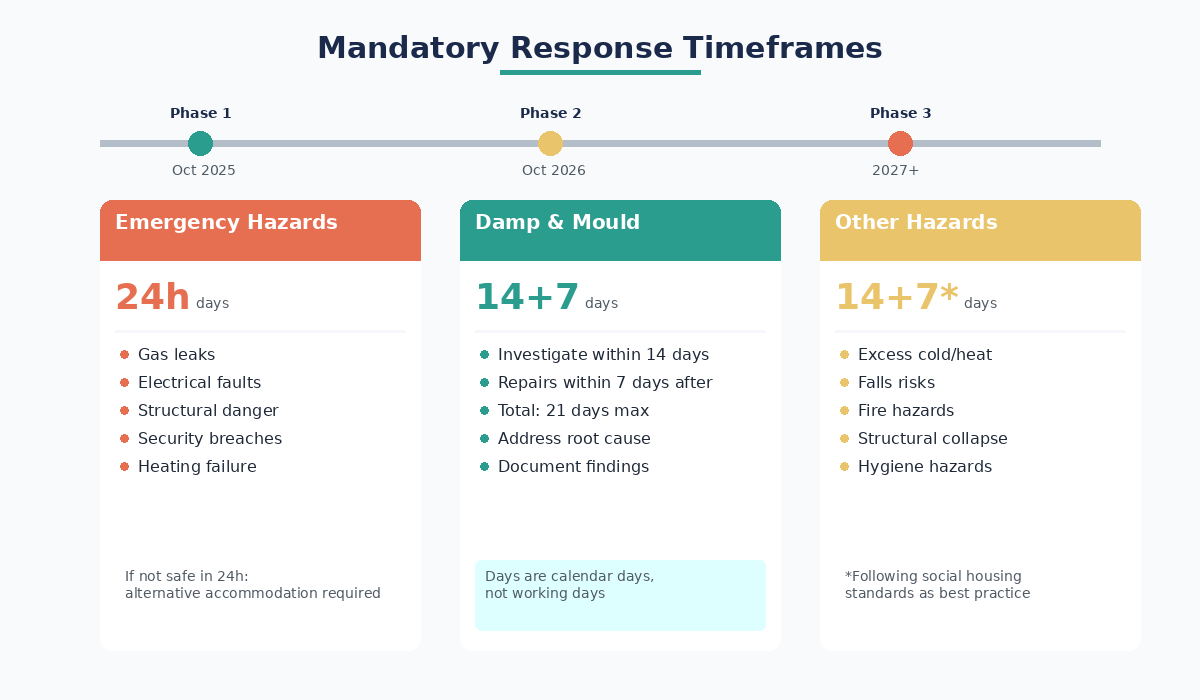
Emergency Hazards — 24 Hours
Emergency hazards must be investigated AND made safe within 24 hours of being reported.
Examples of emergency hazards:
- Dangerous electrical faults
- Major gas leaks
- Damaged external doors or windows (security risk)
- Severe water leaks causing immediate damage
- Complete heating failure in cold weather
- Structural issues posing immediate danger
If you can't make it safe within 24 hours: You must offer alternative accommodation until the hazard is resolved.
Significant Damp and Mould — 14 Working Days Total
For significant damp and mould hazards:
| Stage | Timeframe |
|---|---|
| Investigation | Within 14 calendar days of report |
| Repair completion | Within 7 calendar days of investigation |
Total maximum time: 21 calendar days from report to resolution.
Other Significant Hazards (From October 2026)
The second phase expands requirements to additional hazards:
- Excess cold and excess heat
- Falls (stairs, uneven surfaces)
- Structural collapse and explosions
- Fire hazards
- Electrical hazards
- Domestic and personal hygiene hazards
From 2027: Requirements expand to all remaining hazards under the Housing Health and Safety Rating System (HHSRS), excluding overcrowding.
The Compliance Checklist
Use this checklist to ensure you're meeting Awaab's Law requirements:
Immediate Setup (Do Now)
- Establish a clear reporting channel — Tenants must know exactly how to report issues
- Document your contact methods — Phone, email, app — whatever you use, make it trackable
- Set up emergency contractor contacts — Have 24-hour contacts for gas, electric, plumbing, and glazing
- Create an issue logging system — Every report needs a timestamp and reference number
- Train anyone who receives reports — They need to recognise emergency vs. non-emergency hazards
When a Hazard Is Reported
For Emergency Hazards (24-Hour Response Required):
- Log the report immediately with timestamp
- Acknowledge within 2 hours — Confirm you've received the report
- Assess severity — Is this truly an emergency requiring 24-hour resolution?
- Dispatch contractor or attend yourself — Within hours, not days
- Make the property safe within 24 hours
- If you can't make it safe — Offer alternative accommodation immediately
- Document everything — Photos, contractor reports, timeline of actions
- Confirm resolution with tenant — Get written acknowledgment
For Significant Damp and Mould (14+7 Day Response):
- Log the report with timestamp and photos from tenant
- Acknowledge within 24 hours — Even though you have longer, respond promptly
- Schedule inspection within 14 calendar days
- Conduct thorough investigation — Identify cause, not just symptoms
- Document findings with dated photos and written report
- Create repair plan with timeline
- Complete repairs within 7 calendar days of investigation
- Address root cause — Ventilation, insulation, leaks — not just surface treatment
- Follow up with tenant — Confirm issue is resolved
- Schedule reinspection if ongoing monitoring needed
For Other Significant Hazards:
- Log and acknowledge the report
- Assess against HHSRS criteria — Is this a Category 1 or Category 2 hazard?
- Investigate within reasonable timeframe — Apply 14-day principle pending formal guidance
- Complete repairs promptly — 7 days post-investigation as standard
- Document everything — Your evidence protects you
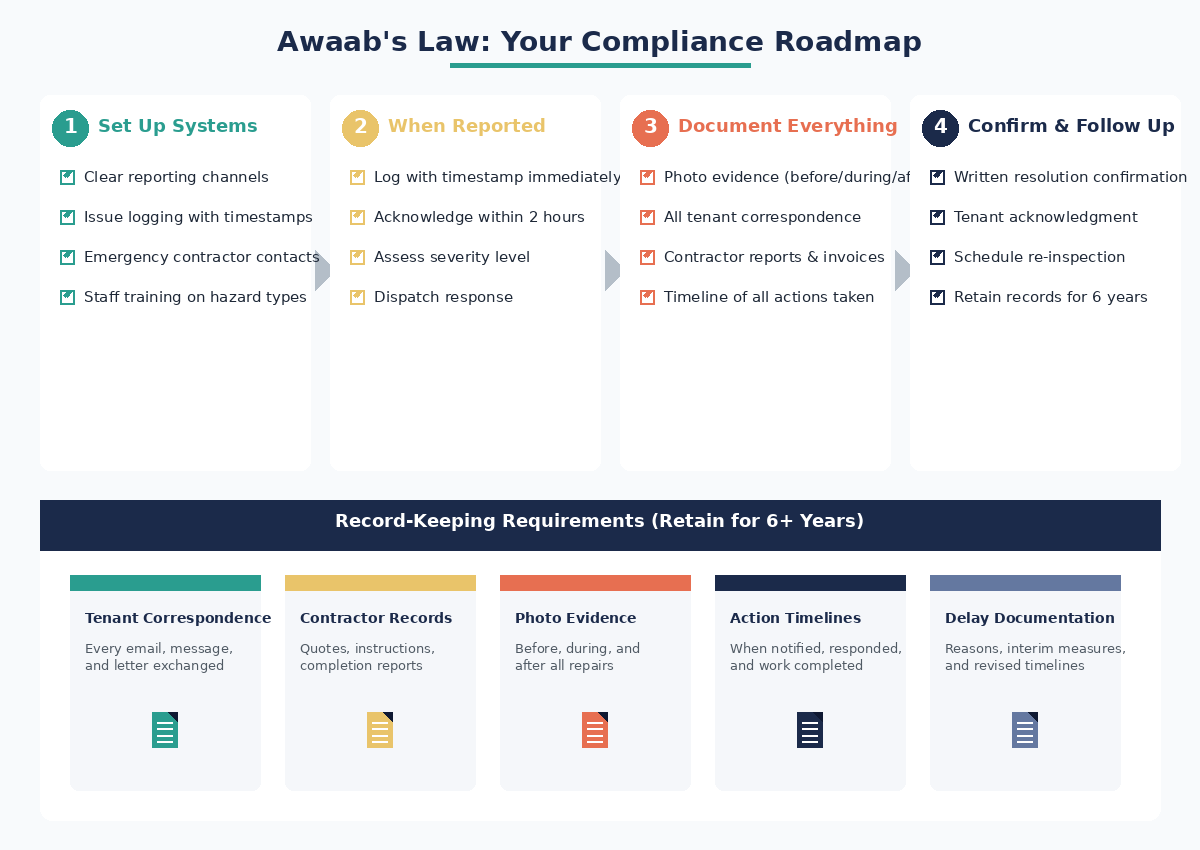
Record-Keeping Requirements
Awaab's Law explicitly requires landlords to maintain clear records. You must keep:
- All correspondence with tenants — Every email, message, letter
- All correspondence with contractors — Quotes, instructions, completion reports
- Photographic evidence — Before, during, and after repairs
- Timeline of actions — When you were notified, when you responded, when work completed
- Reasons for any delays — If circumstances beyond your control caused delays, document them
Retention period: Keep records for at least 6 years (limitation period for housing disrepair claims).
If You Can't Meet the Deadlines
Sometimes circumstances genuinely prevent compliance:
- Document the reason — Contractor unavailability, tenant access issues, parts on order
- Communicate with the tenant — Explain the delay and revised timeline
- Take interim measures — Temporary heating, dehumidifiers, alternative accommodation
- Keep trying — Good faith efforts matter in tribunals
- Get written evidence — Contractor correspondence, supplier delivery confirmations
What Happens If You Don't Comply?
Current Enforcement (Social Housing)
For social landlords, non-compliance can result in:
- Legal action by tenants for breach of contract
- Investigation by the Housing Ombudsman
- Severe maladministration findings
- Compensation orders
- Regulatory intervention by the Regulator of Social Housing
Coming Enforcement (Private Sector)
When Awaab's Law extends to private landlords:
- Local authority enforcement action
- Civil penalties (expected to be significant)
- Banning orders for repeat offenders
- Rent Repayment Orders (tenants can claim back rent)
- Tribunal findings against you in possession claims
Tribunal Impact Now
Even before formal enforcement, tribunals already consider:
- How quickly you responded to hazard reports
- Whether you documented your actions
- Whether your response was reasonable
- The impact on the tenant's health and wellbeing
Slow responses without documentation lose cases. This is true today, not just after formal implementation.
Preparing Your Systems
Communication Infrastructure
Your reporting system should:
- Create automatic timestamps — No ability to backdate
- Generate acknowledgment records — Prove you received the report
- Track response times — Know exactly how long each stage takes
- Store all correspondence — Immutable records you can export
- Integrate with your workflow — Contractor dispatch, scheduling, completion
WhatsApp groups and email chains fail on most of these requirements. Consider purpose-built property communication platforms that create evidence-grade records.
Contractor Network
Build relationships with:
- 24-hour emergency services — Gas Safe engineer, electrician, plumber, locksmith
- Damp and mould specialists — Not just painters and decorators
- General maintenance contractors — With guaranteed response times
- Backup contractors — When your primary is unavailable
Get their emergency contact details in writing. Know their callout fees. Have payment arrangements in place so there's no delay when you need them.
Inspection Protocols
Establish regular inspection schedules:
- Move-in inspection — Baseline condition with photos
- Periodic inspections — 6-monthly or annually, documented
- Seasonal checks — Heating before winter, ventilation in summer
- Post-repair verification — Confirm work completed properly
The Bigger Picture: Why This Matters
Awaab's Law isn't just about compliance boxes. It's about recognising that housing conditions directly affect health — and that landlords have a duty of care to their tenants.
The landlords who embrace this shift will find:
- Fewer disputes escalating to tribunals
- Better tenant relationships and retention
- Stronger defence when issues do arise
- Lower long-term repair costs (early intervention is cheaper)
- Reputation protection in an era of public landlord ratings
The landlords who ignore it will find:
- Increasing legal exposure
- Difficulty obtaining possession when needed
- Regulatory penalties and potential banning
- Reputational damage
- Mounting repair costs from neglected issues
Quick Reference: Response Time Summary
| Hazard Type | Investigation | Resolution | Total Time |
|---|---|---|---|
| Emergency | Immediate | 24 hours | 24 hours |
| Damp & Mould | 14 days | 7 days after | 21 days |
| Other Significant | 14 days* | 7 days after* | 21 days* |
*Pending formal guidance for private sector; following social housing standards as best practice.
Download the Checklist
Want a printable version of this checklist? Download the PDF to keep on hand for every property in your portfolio.
Frequently Asked Questions
Q: When does Awaab's Law apply to private landlords? A: Awaab's Law is currently in force for social housing (since October 2025). The Renters' Rights Act 2025 contains provisions to extend it to the private rented sector, likely in 2027. However, tribunals already consider response times when assessing landlord conduct.
Q: What counts as an "emergency hazard" under Awaab's Law? A: Emergency hazards include dangerous electrical faults, major gas leaks, damaged external doors or windows (security risk), severe water leaks, complete heating failure in cold weather, and structural issues posing immediate danger.
Q: What if I can't complete repairs within the deadline? A: Document the reason (contractor unavailability, parts on order), communicate with the tenant immediately, and take interim measures. If you can't make an emergency hazard safe within 24 hours, you must offer alternative accommodation.
Q: How do I prove when a tenant reported an issue? A: You need timestamped, immutable records. WhatsApp and email can be disputed — consider using evidence-grade communication platforms that create server-side timestamps that can't be manipulated.
Q: Does Awaab's Law apply to all hazards? A: The law is being implemented in phases. Phase 1 covers emergency hazards and significant damp and mould. Phase 2 (from October 2026) adds excess cold/heat, falls, structural collapse, fire, electrical, and hygiene hazards. By 2027, it covers all HHSRS hazards except overcrowding.
This guide is for informational purposes and does not constitute legal advice. Requirements may change as the private sector implementation is finalised. For specific situations, consult a qualified property solicitor.
Further Reading:
Sources:
Replace checklists with automatic tracking
Togal turns this checklist into a live compliance dashboard. Every item tracked, every deadline monitored, every document stored.
Used by landlords managing 1 to 50+ properties across the UK.
Start Your Free Trial14-day free trial · Cancel anytime