
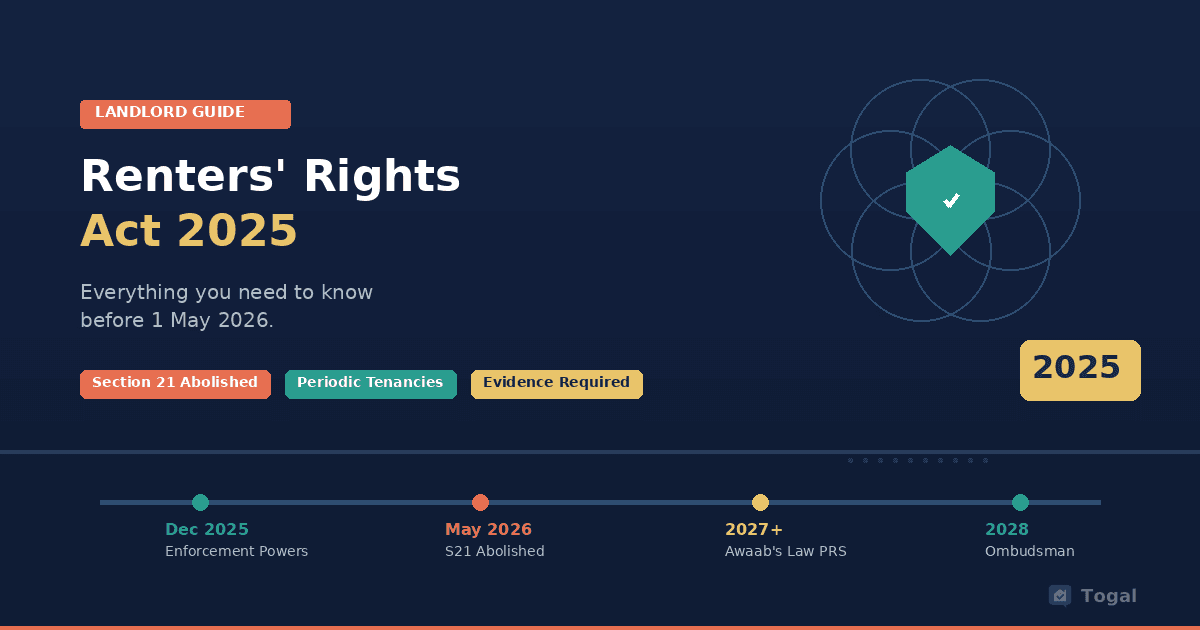
Renters' Rights Act 2025: The Complete Landlord Guide
Everything you need to know before 1 May 2026
Quick Answer: The Renters' Rights Act 2025 abolishes Section 21 "no-fault" evictions from 1 May 2026. All tenancies become periodic (no fixed terms), and every eviction now requires documented evidence under Section 8. Landlords must prepare by setting up proper documentation systems before the deadline.
The Renters' Rights Act 2025 is the biggest shake-up to private renting since the Housing Act 1988. Section 21 "no-fault" evictions are gone. Fixed-term tenancies are history. And every landlord in England needs to understand what's changing before the law comes into force on 1 May 2026.
This guide breaks down exactly what's happening, when it's happening, and what you need to do to stay compliant.
What Is the Renters' Rights Act 2025?
The Renters' Rights Act received Royal Assent on 27 October 2025. It fundamentally reforms the private rented sector to give 11 million renters in England stronger rights, better protections, and more security in their homes.
For landlords, this means a new operating model. The days of ending tenancies without reason are over. From now on, every eviction requires valid grounds and evidence to prove them.
Key Changes Coming on 1 May 2026
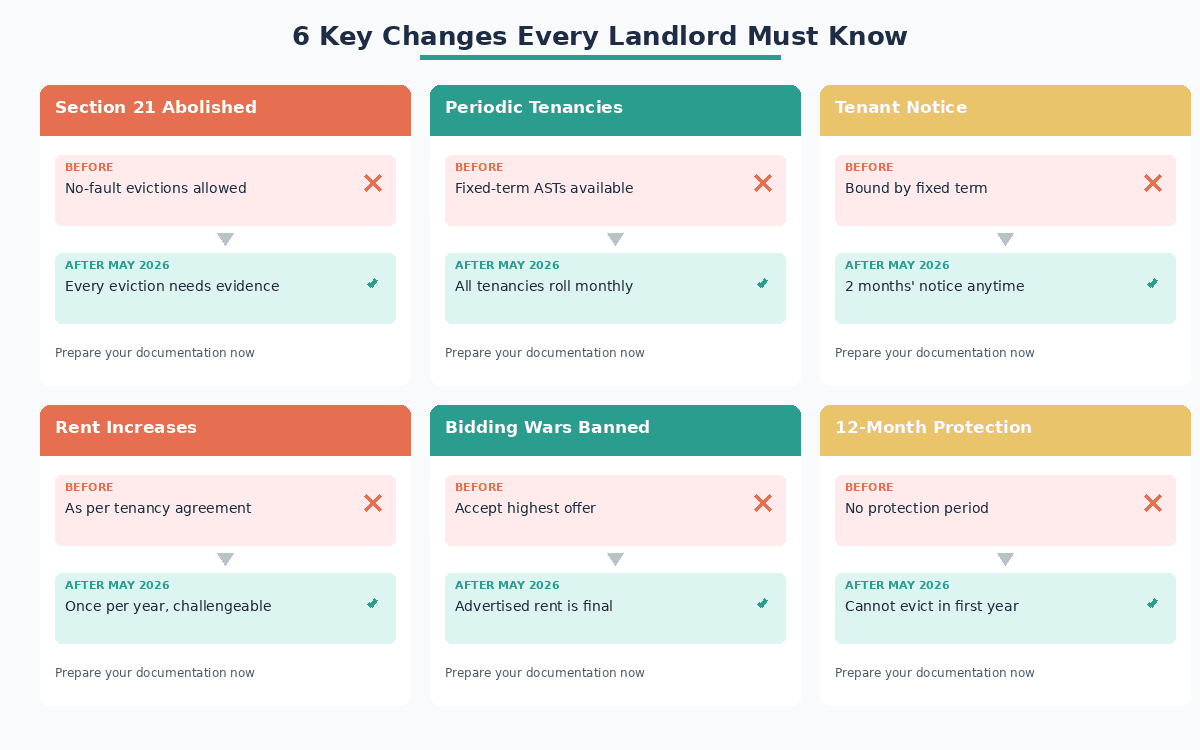
1. Section 21 "No-Fault" Evictions Abolished
The change that makes headlines. After 1 May 2026, landlords cannot evict tenants without a valid reason. Every possession claim must use Section 8 of the Housing Act 1988 and demonstrate one of the 37 grounds for possession.
What this means in practice:
- You need documented evidence for every eviction
- Vague complaints won't hold up in court
- The burden of proof rests entirely with you
2. All Tenancies Become Periodic
Fixed-term assured shorthold tenancies (ASTs) are being replaced by assured periodic tenancies (APTs). All tenancies will roll on from month to month with no fixed end date.
Existing tenancies: Your current ASTs will automatically convert to periodic tenancies on 1 May 2026. You don't need to issue new agreements, but you must provide tenants with a government "information sheet" by 31 May 2026 explaining the new rules.
New tenancies: From 1 May 2026, all new tenancies are periodic from day one.
3. Tenants Can Leave with 2 Months' Notice
Under the new system, tenants can end their tenancy at any time by giving two months' notice. No break clauses needed. No waiting for a fixed term to end.
This flexibility benefits responsible tenants while potentially increasing void periods for landlords. Factor this into your financial planning.
4. Rent Increases Limited to Once Per Year
Landlords can only increase rent once every 12 months, using a Section 13 notice. Tenants can challenge increases they consider above market rate at the First-tier Tribunal.
Important: The tribunal will only consider what a fair market rent would be — they can't reduce the rent below what you've proposed, but they can refuse an above-market increase.
5. Bidding Wars Banned
You can no longer accept offers above your advertised rent. The rent you market is the rent you must charge. This applies to both direct lets and those through letting agents.
6. 12-Month Protected Period for New Tenants
Landlords cannot use certain possession grounds (including selling the property or moving in) during the first 12 months of a new tenancy. This "protected period" ensures tenants have stability when they first move in.
The New Possession Grounds Explained
The reformed Schedule 2 of the Housing Act 1988 now contains 37 grounds for possession — expanded from 17 under the previous legislation. Here are the most relevant for private landlords:
Mandatory Grounds (Court Must Grant Possession)
| Ground | Reason | Notice Period |
|---|---|---|
| Ground 1 | Landlord requires property as own home | 4 months |
| Ground 1A | Landlord intends to sell the property | 4 months |
| Ground 2 | Mortgage lender exercising power of sale | 2 months |
| Ground 6 | Landlord intends to demolish or reconstruct | 4 months |
| Ground 8 | Rent arrears of 3+ months | 4 weeks |
Discretionary Grounds (Court May Grant Possession)
| Ground | Reason | Notice Period |
|---|---|---|
| Ground 10 | Some rent is unpaid | 4 weeks |
| Ground 11 | Persistent late payment | 4 weeks |
| Ground 12 | Breach of tenancy terms | 4 weeks |
| Ground 14 | Nuisance or anti-social behaviour | Immediate (serious) or 4 weeks |
Key Changes to Existing Grounds
Ground 8 (Rent Arrears): Now requires 3 months' arrears (increased from 2 months) at both the notice date AND the court hearing date.
Ground 1A (Sale): New mandatory ground allowing possession when genuinely intending to sell. Requires 4 months' notice and cannot be used in the first 12 months. After possession, you cannot re-let for 12 months.
Ground 14 (Anti-Social Behaviour): Threshold lowered to behaviour "capable of causing" nuisance, and proceedings can begin immediately for serious cases.
Evidence Requirements: The New Reality
With Section 21 gone, evidence is everything. Every possession claim requires documentation that proves your grounds. Courts will scrutinise your records.
What Counts as Evidence?
For rent arrears:
- Complete payment history with dates
- Copies of rent demands sent
- Bank statements showing non-receipt
- Communication attempts documented
For anti-social behaviour:
- Timestamped incident logs
- Witness statements with dates
- Police reports or crime reference numbers
- Letters of complaint from neighbours
- Photographs or video where appropriate
For property condition breaches:
- Dated photographs of damage
- Inspection reports
- Correspondence requesting remedy
- Evidence of costs incurred
For selling or moving in:
- Estate agent instructions (Ground 1A)
- Marketing evidence
- Statement of genuine intention
Why Timestamps Matter
In a tribunal, your word isn't enough. You need to prove:
- When you reported an issue or received a complaint
- What was communicated and by whom
- Whether the tenant responded and when
WhatsApp messages can be deleted. Emails can be "lost." Phone calls leave no trace. Evidence-grade communication platforms create immutable records that hold up in court.
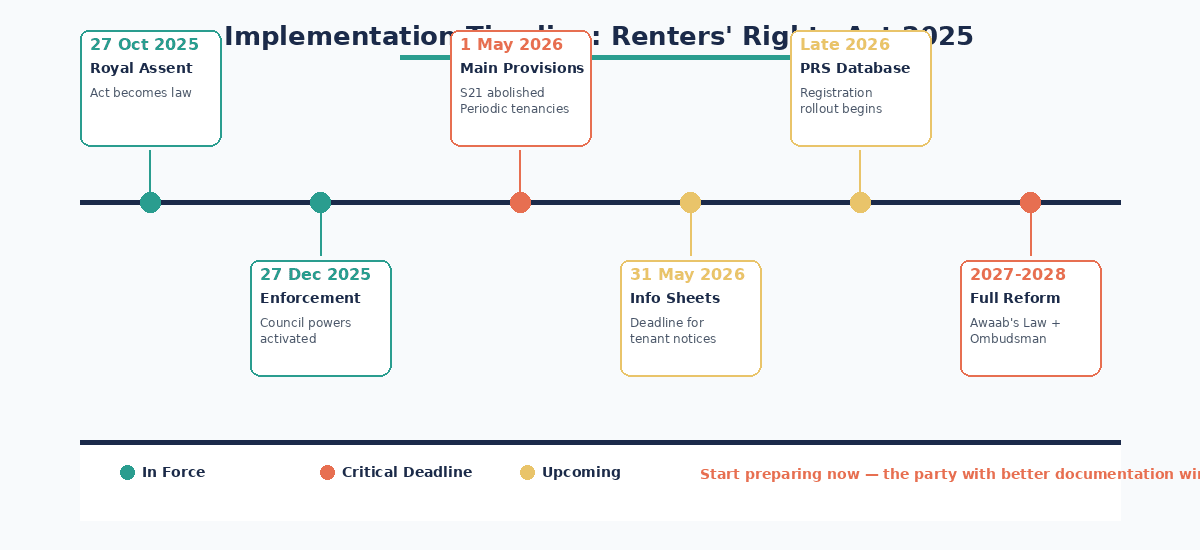
Implementation Timeline
| Date | What Happens |
|---|---|
| 27 December 2025 | New enforcement powers for local councils |
| 1 May 2026 | Main provisions come into force (Section 21 abolished, periodic tenancies, etc.) |
| 31 May 2026 | Deadline to provide existing tenants with government information sheet |
| Late 2026 | PRS Database begins rollout |
| 2027+ | Awaab's Law extended to private rented sector |
| 2028 | Landlord Ombudsman expected to launch |
| 2028 | Ombudsman membership becomes mandatory |
What You Need to Do Now
Before 1 May 2026
-
Review your existing tenancies. Understand which are converting to periodic and any outstanding issues.
-
Set up proper documentation systems. Get out of WhatsApp and email chains. Use a platform that creates timestamped, immutable records.
-
Update your compliance tracking. Gas safety, EICR, EPC, deposit protection — make sure everything is current and you can prove it.
-
Understand the new grounds. Know which apply to your situation and what evidence you'd need.
-
Review your tenant screening. Without Section 21 as a safety net, getting the right tenant matters more than ever.
On 1 May 2026
-
Existing ASTs convert automatically. No action needed on the agreement itself.
-
Provide the government information sheet. You have until 31 May 2026, but don't leave it late.
-
Update your processes. Rent increase procedures, maintenance response systems, communication channels.
Ongoing
-
Document everything. Every conversation, every complaint, every repair request.
-
Respond to issues promptly. Awaab's Law is coming to the private sector, and response times will be legally mandated.
-
Stay current with regulations. The PRS Database and Ombudsman are coming. Be ready.
The Bottom Line
The Renters' Rights Act 2025 doesn't make being a landlord impossible — but it does make poor documentation costly. The landlords who thrive under the new system will be those who:
- Treat communication as evidence
- Track compliance proactively
- Respond to issues with documented timelines
- Build relationships based on transparency
The party with better documentation wins. That's always been true in tribunals, and it's about to become the defining factor in every landlord-tenant dispute.
Frequently Asked Questions
Q: Does this apply to Scotland, Wales, or Northern Ireland? A: No. The Renters' Rights Act 2025 applies to England only. Scotland, Wales, and Northern Ireland have their own tenancy frameworks.
Q: What if I have a fixed-term tenancy that ends after 1 May 2026? A: Fixed-term tenancies cannot exist after 1 May 2026. Your tenancy will automatically convert to a periodic tenancy on that date, regardless of what your agreement says.
Q: Can I still evict a tenant who doesn't pay rent? A: Yes, but the threshold for mandatory possession (Ground 8) has increased to 3 months' arrears, up from 2 months. You'll need documented evidence of the arrears.
Q: What happens if I want to sell my property? A: New Ground 1A provides a mandatory ground for possession when selling. You must give 4 months' notice and cannot use this in the first 12 months of a tenancy. After possession, you cannot re-let for 12 months.
Q: How do I prove when a tenant reported an issue? A: You need timestamped records. Email works, but timestamps can be disputed. Evidence-grade platforms create immutable records with verified timestamps that hold up in court.
This guide is for informational purposes and does not constitute legal advice. For specific situations, consult a qualified property solicitor.
Further Reading:
- Section 8 Evidence Guide: What You Need to Prove Each Ground
- Awaab's Law Compliance Checklist
- WhatsApp vs Evidence Platforms: Why Your Communication Tool Matters
Sources:
About the Author
Togal Team
Content Team
The Togal team writes about UK rental regulations, compliance best practices, and evidence-based communication for landlords and tenants.
View all posts by Togal