
Section 8 Evidence Guide: Building Your Possession Case Under the Renters' Rights Act
With Section 21 gone, every eviction requires documented grounds. Here's exactly what evidence you need for each possession ground.
Quick Answer: After 1 May 2026, every eviction must use Section 8 with documented evidence proving your grounds. For rent arrears (Ground 8), you need 3 months' arrears with complete payment records. For anti-social behaviour (Ground 14), you need timestamped incident logs, witness statements, and police reports. The party with better documentation wins.
The Renters' Rights Act 2025 abolished Section 21 "no-fault" evictions on 1 May 2026. Every possession claim now goes through Section 8 of the Housing Act 1988, and every Section 8 case requires evidence.
This isn't optional. Courts scrutinise documentation. Judges expect proof. The party with better evidence wins.
The New Reality: Evidence-First Evictions
Under the old system, landlords could serve a Section 21 notice, wait two months, and apply for possession without giving a reason. That's gone.
Now, every eviction must:
- Use one of the 37 grounds for possession in Schedule 2 of the Housing Act 1988
- Provide the correct notice period (varies by ground)
- Demonstrate evidence proving that ground applies
The burden of proof rests entirely with the landlord. If you can't prove it, you don't get possession.
Evidence Requirements by Ground
Ground 8: Serious Rent Arrears (Mandatory)
What it requires: The tenant owes at least 3 months' rent at both:
- The date you serve the Section 8 notice
- The date of the court hearing
Notice period: 4 weeks
Evidence needed:
| Document | Purpose | Critical Details |
|---|---|---|
| Complete rent ledger | Proves arrears amount | Must show dates, amounts due, amounts paid |
| Bank statements | Corroborates non-payment | Highlight missing payments |
| Rent demands sent | Shows tenant was informed | Keep copies with timestamps |
| Tenancy agreement | Proves rent amount and due dates | Signed copy |
Key points:
- Arrears must be 3 full months (increased from 2 months under previous rules)
- If tenant pays down to below 3 months before the hearing, Ground 8 fails
- Keep your rent records updated to the day of the hearing
Common mistakes:
- Informal records (handwritten notes won't hold up)
- Missing dates on payment records
- Not accounting for partial payments correctly
- Serving notice when arrears are 2.9 months
Ground 10/11: Some Rent Arrears or Persistent Late Payment (Discretionary)
What they require:
- Ground 10: Some rent is lawfully due (any amount)
- Ground 11: Tenant has persistently delayed paying rent
Notice period: 4 weeks
Evidence needed:
For Ground 10:
- Current rent statement showing amount owed
- Rent ledger showing payment history
- Bank statements
For Ground 11:
- 12 months minimum of payment history showing pattern
- Clear record of due dates vs. actual payment dates
- Communication about late payments (warnings, reminders)
What courts consider (discretionary grounds):
- Tenant's circumstances and reasons for non-payment
- Whether landlord has been reasonable
- Whether tenant has a realistic plan to clear arrears
- Impact on landlord if possession not granted
Critical: These are discretionary. Even with perfect evidence, a judge may refuse possession if they believe it's unreasonable in the circumstances.
Ground 12: Breach of Tenancy Terms (Discretionary)
What it requires: The tenant has broken one or more conditions of the tenancy agreement (other than rent payment).
Notice period: 4 weeks
Common breaches:
- Subletting without permission
- Keeping pets when prohibited
- Running a business from the property
- Making alterations without consent
- Causing damage beyond normal wear and tear
Evidence needed:
| Type of Breach | Evidence Required |
|---|---|
| Subletting | Proof of other occupants (photos, statements, utility bills in different names) |
| Pets | Photos, neighbour statements, inspection reports |
| Damage | Dated photos, repair quotes, inventory comparison, inspection records |
| Business use | Evidence of commercial activity (deliveries, signage, customer visits) |
What you must prove:
- The tenancy agreement contains the term that was breached
- The term is lawful and enforceable
- The breach actually occurred
- The breach is serious enough to warrant possession
Court considerations:
- How serious is the breach?
- Has the tenant remedied the breach?
- Was the tenant warned before proceedings?
- What would be proportionate?
Ground 14: Nuisance or Anti-Social Behaviour (Discretionary/Mandatory)
What it requires: The tenant, or someone living with or visiting them, has been guilty of conduct causing or likely to cause nuisance or annoyance.
Notice period:
- Serious cases: Can be immediate (0 days)
- Standard cases: 4 weeks
Expanded under Renters' Rights Act 2025: The threshold is now behaviour "capable of causing" nuisance, not just behaviour that actually caused it.
Evidence needed:
| Source | What to Record |
|---|---|
| Incident log | Date, time, description, who was affected |
| Witness statements | Signed and dated, with contact details |
| Police reports | Crime reference numbers, officer statements |
| Council complaints | Reference numbers, Environmental Health reports |
| Photographs/video | Timestamped, showing what occurred |
| Audio recordings | Where legally obtained |
Building a strong case:
- Keep a contemporaneous log: Record incidents as they happen, not days or weeks later
- Multiple witnesses: One complaint is weak; multiple neighbours is strong
- Official involvement: Police and council involvement adds weight
- Pattern of behaviour: One incident is rarely enough; document the pattern
- Impact evidence: Record how the behaviour affected others
For serious cases (immediate possession):
- Domestic violence or abuse
- Threats of violence
- Drug dealing from the property
- Behaviour causing significant risk
Tip: Courts give significant weight to police involvement. Always report serious incidents and get crime reference numbers.
Ground 1: Landlord's Own Home (Mandatory)
What it requires: The landlord requires the property as their own principal home (or their spouse/civil partner's).
Notice period: 4 months
12-month restriction: Cannot be used in the first 12 months of a tenancy (new under Renters' Rights Act 2025).
Evidence needed:
| Document | Purpose |
|---|---|
| Statement of intention | Why you need to live there |
| Evidence of current housing situation | Tenancy ending, sale completing, etc. |
| Family circumstances | Marriage, divorce, children, etc. |
| Prior notice given (Ground 1(a)) | If you notified tenant at start that you might need property back |
What courts consider:
- Is your stated intention genuine?
- Do you have realistic plans to move in?
- Is there evidence this is a pretext to re-let at higher rent?
After using Ground 1:
- You cannot re-let the property for 12 months
- Penalty for breach: 6 months' rent compensation to new tenant
Ground 1A: Sale of Property (Mandatory)
What it requires: The landlord intends to sell the property (freehold or lease of 7+ years).
Notice period: 4 months
12-month restriction: Cannot be used in the first 12 months of a tenancy.
Evidence needed:
| Document | Purpose |
|---|---|
| Estate agent instructions | Shows genuine intention to sell |
| Marketing materials | Proves property is/will be marketed |
| Solicitor correspondence | If sale is in progress |
| Statement of intention | Why you're selling |
What courts consider:
- Is the intention to sell genuine and not a pretext?
- Are there concrete steps towards marketing/sale?
After using Ground 1A:
- You cannot re-let the property for 12 months
- If you don't complete the sale and re-let instead, tenant can claim compensation
Ground 6: Demolition or Reconstruction (Mandatory)
What it requires: The landlord intends to demolish, reconstruct, or carry out substantial works that cannot be done with the tenant in occupation.
Notice period: 4 months
Evidence needed:
- Planning permission or building regulations approval
- Architects' plans and specifications
- Contractor quotes and schedules
- Statement explaining why works cannot be done with tenant in situ
- Timeline for works
Key test: You must demonstrate the works genuinely cannot be completed with the tenant remaining. Courts will ask whether alternative arrangements are possible.
Evidence Quality Standards
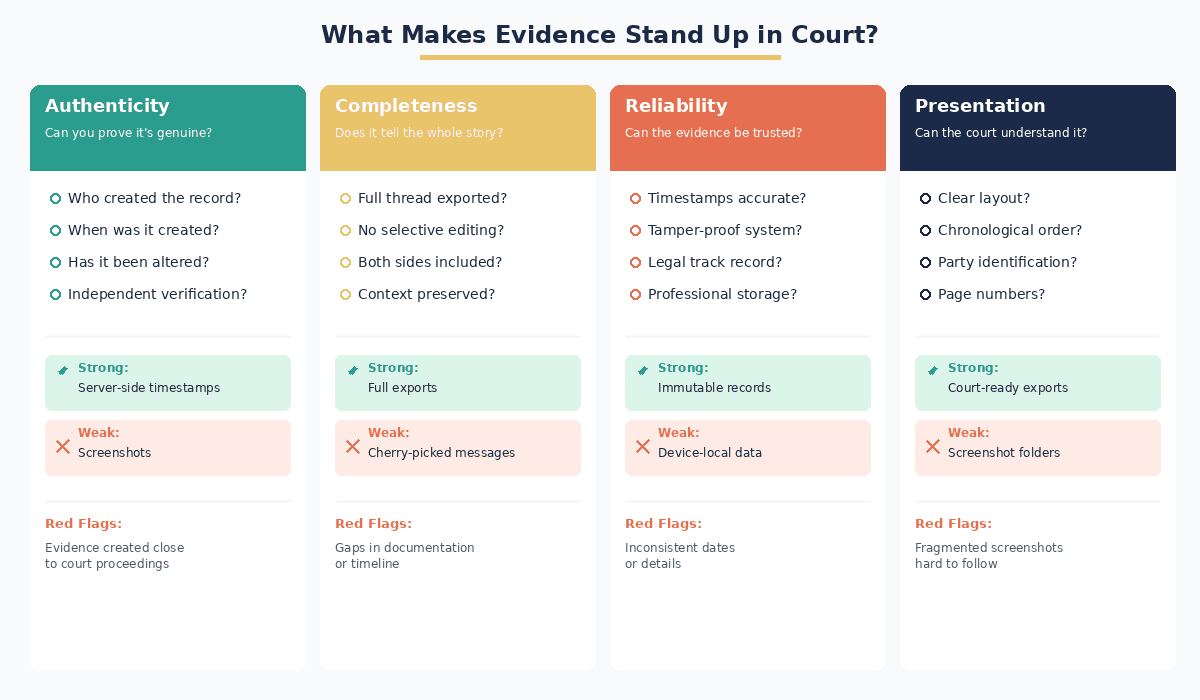
What Makes Evidence "Good"?
Timestamps matter:
- When was this document created?
- When was this communication sent?
- When was this photo taken?
Provenance matters:
- Who created this record?
- How was it stored?
- Can you prove it hasn't been altered?
Completeness matters:
- Does your evidence tell the whole story?
- Are there gaps that the tenant's solicitor will exploit?
- Have you disclosed everything (even if some of it helps the tenant)?
Creating Evidence-Grade Records
Communications:
- Use platforms that create immutable timestamps
- Avoid WhatsApp and text messages where possible (easily deleted, hard to authenticate)
- Email is better but can still be disputed
- Purpose-built property communication platforms create records designed for court
Photographs:
- Enable timestamp metadata on your camera/phone
- Take photos as issues arise, not weeks later
- Include reference points (newspapers, dated objects) in serious cases
- Store originals — don't edit or filter
Inspection reports:
- Conduct regular documented inspections
- Have the tenant sign to acknowledge your findings
- Photograph any issues found
- Keep historical inspection records
Financial records:
- Use accounting software or a proper rent ledger
- Never rely on memory or informal notes
- Reconcile with bank statements regularly
The Pre-Action Protocol
Before starting court proceedings for rent arrears, you must follow the Pre-Action Protocol for Possession Claims by Social Landlords. Although originally designed for social landlords, courts increasingly expect private landlords to follow similar principles.
Required steps:
- Provide clear rent statements showing how arrears have accrued
- Make contact to discuss the arrears and reasons behind them
- Offer payment arrangements before seeking possession
- Signpost support services (debt advice, housing options)
- Allow reasonable time for the tenant to seek advice
- Consider alternatives to possession proceedings
Document everything: Your compliance with the Protocol should be evidenced. If a judge asks whether you followed the Protocol and you can't prove it, your case is weakened.
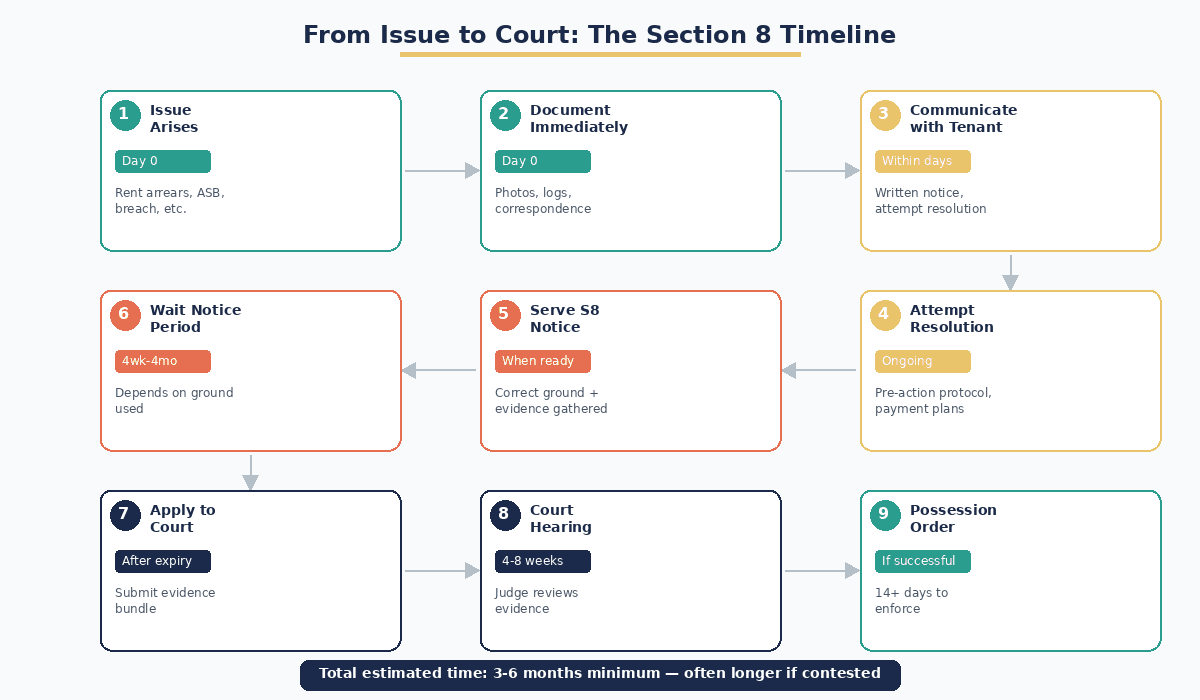
Timeline: From Issue to Court
| Stage | Action | Timeline |
|---|---|---|
| 1 | Issue arises | Day 0 |
| 2 | Document the issue | Immediately |
| 3 | Communicate with tenant | Within days |
| 4 | Attempt resolution | Ongoing |
| 5 | Serve Section 8 notice | When evidence is ready |
| 6 | Wait notice period | 4 weeks to 4 months depending on ground |
| 7 | Apply to court | After notice expires |
| 8 | Court hearing | 4-8 weeks after application |
| 9 | Possession order | If successful |
| 10 | Enforcement (if needed) | 14+ days after order |
Total time: 3-6 months minimum in most cases, often longer if contested.
What Happens When Evidence Is Weak?
Discretionary grounds: The court may refuse possession, even if the ground technically applies.
Mandatory grounds: The court must grant possession if the ground is made out — but you still need to prove it was made out.
Common failures:
- Rent arrears not quite at threshold by hearing date
- Undocumented incidents that become "your word against theirs"
- Missing records that create reasonable doubt
- Evidence that looks fabricated or inconsistent
- Failure to follow proper procedures
The cost of failure:
- Wasted court fees (£255-355+)
- Wasted legal fees (if using a solicitor)
- Months of delay
- Emboldened tenant who knows your case is weak
- Having to start again from scratch
Building Your Evidence System
Minimum Requirements
- Rent tracking: Formal ledger showing all amounts due and paid, with dates
- Communication records: Timestamped copies of all correspondence
- Inspection records: Regular documented inspections with photos
- Issue logging: Record of all maintenance reports and responses
- Incident documentation: Log of any breaches, nuisance, or complaints
Best Practice
- Use a property management platform designed for evidence
- Conduct inspections on a regular schedule (quarterly or biannually)
- Respond to all tenant communications in writing
- Create records contemporaneously (at the time, not retrospectively)
- Keep backups of all documentation
Red Flags Courts Look For
- Evidence created close to court proceedings
- Gaps in documentation
- Inconsistent dates or details
- Lack of corroboration
- Evidence that appears reconstructed rather than contemporaneous
Summary: The Evidence Checklist
Before serving a Section 8 notice, ask yourself:
- Do I have the right ground? Check the ground genuinely applies to my situation
- Do I have the evidence to prove it? Not just believe it — prove it to a judge
- Is my evidence contemporaneous? Created at the time, not reconstructed later
- Is my evidence complete? Tells the whole story without gaps
- Can I authenticate my evidence? Prove it's genuine and unaltered
- Have I followed procedures? Notice periods, Pre-Action Protocol, proper forms
- Am I prepared to be challenged? Evidence must survive cross-examination
If you can't answer "yes" to all of these, your case isn't ready.
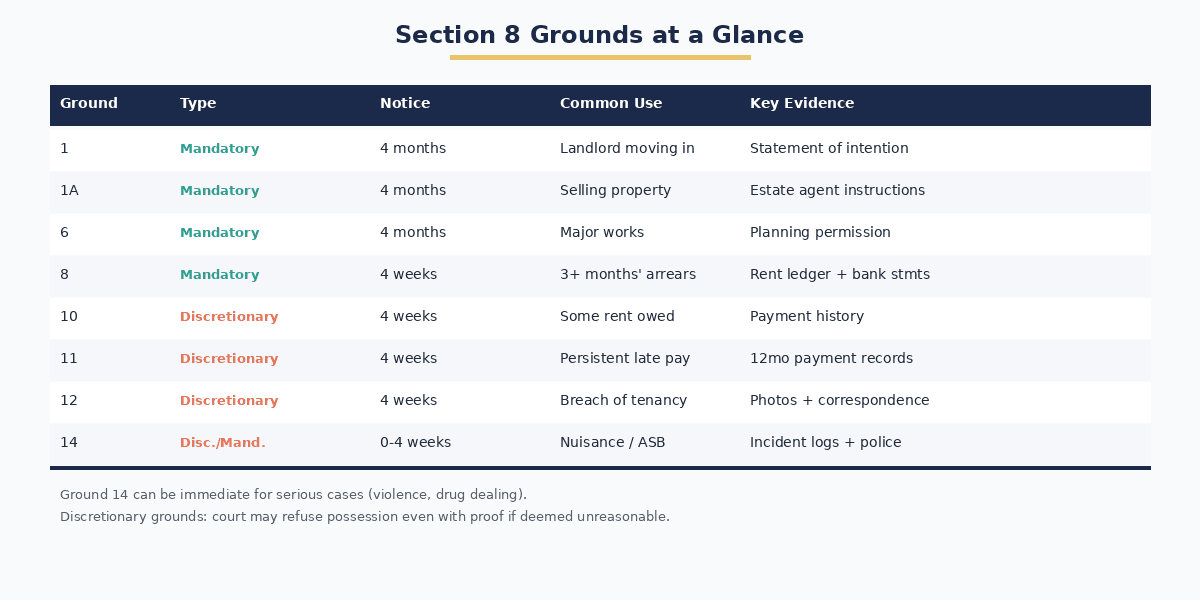
Quick Reference: Grounds at a Glance
| Ground | Type | Notice | Common Use |
|---|---|---|---|
| 1 | Mandatory | 4 months | Landlord moving in |
| 1A | Mandatory | 4 months | Selling property |
| 2 | Mandatory | 2 months | Mortgage lender possession |
| 6 | Mandatory | 4 months | Major works/demolition |
| 8 | Mandatory | 4 weeks | 3+ months' rent arrears |
| 10 | Discretionary | 4 weeks | Some rent owed |
| 11 | Discretionary | 4 weeks | Persistent late payment |
| 12 | Discretionary | 4 weeks | Breach of tenancy |
| 14 | Discretionary* | 0-4 weeks | Nuisance/ASB |
*Ground 14 can be immediate for serious cases.
Frequently Asked Questions
Q: How long does a Section 8 eviction take? A: Typically 3-6 months minimum. This includes notice period (4 weeks to 4 months depending on ground), court application, hearing (4-8 weeks after application), and enforcement if needed.
Q: What's the difference between mandatory and discretionary grounds? A: For mandatory grounds (like Ground 8 rent arrears), the court must grant possession if you prove the ground applies. For discretionary grounds (like Ground 10 or 12), the court may refuse possession even with proof if they consider it unreasonable.
Q: Can I still evict for rent arrears under the new rules? A: Yes, but the threshold for mandatory possession (Ground 8) has increased to 3 months' arrears (up from 2 months). You'll need documented evidence of arrears at both the notice date and court hearing date.
Q: What if my WhatsApp messages prove my case? A: WhatsApp evidence is problematic in court. Messages can be deleted, timestamps are device-local (can be manipulated), and there's no independent verification. Learn more about why evidence platforms beat WhatsApp in court.
Q: What's the Pre-Action Protocol and do I have to follow it? A: The Pre-Action Protocol requires landlords to contact tenants about arrears, offer payment arrangements, and signpost support services before court proceedings. While originally for social landlords, courts increasingly expect private landlords to follow similar principles.
This guide is for informational purposes and does not constitute legal advice. Possession proceedings can be complex and the consequences of getting it wrong are significant. For specific situations, especially high-value or contested cases, consult a qualified property solicitor.
Further Reading:
- Renters' Rights Act 2025 Landlord Guide
- Awaab's Law Compliance Checklist
- WhatsApp vs Evidence Platforms
Sources:
About the Author
Togal Team
Content Team
The Togal team writes about UK rental regulations, compliance best practices, and evidence-based communication for landlords and tenants.
View all posts by Togal