
WhatsApp vs Evidence Platforms: Why Your Communication Tool Matters in Court
You can message tenants however you like — until you need to prove what was said. Then your choice of platform becomes critical.
Quick Answer: WhatsApp messages can be deleted, timestamps manipulated, and there's no independent verification — making them weak evidence in tribunals. Evidence-grade platforms create immutable, server-timestamped records that can't be disputed, which is critical now that every eviction requires documented proof under the Renters' Rights Act 2025.
Every landlord communicates with tenants. Maintenance requests, rent reminders, inspection notices, general check-ins. Most of this happens on WhatsApp, text messages, or email chains.
It works fine for everyday communication. But when disputes arise — and they will — you'll discover that "fine for communication" and "valid for evidence" are very different things.
The Problem with Informal Communication
WhatsApp is convenient. Everyone has it. Messages appear instantly. You can share photos. What's not to like?
For evidence purposes:
| Feature | Problem |
|---|---|
| Messages can be deleted | By either party, at any time |
| Timestamps are device-local | Can be manipulated by changing phone date |
| No export designed for legal use | Screenshots are easily disputed |
| Backup controlled by user | No independent verification |
| End-to-end encryption | Good for privacy, bad for producing evidence |
| Read receipts optional | Can't prove message was seen |
The core issue: WhatsApp creates records you control. In a dispute, the other party will argue you could have fabricated, edited, or selectively exported those records. And they'd be right.
Text Messages (SMS)
Traditional SMS has slightly better standing than WhatsApp because messages are stored by the network operator. But:
- Operators typically only retain records for 12-24 months
- Obtaining records requires formal requests (and sometimes court orders)
- Photos and media sent via MMS have poor metadata
- No read receipts
- Easily confused with other messaging apps that look similar
Email is better than WhatsApp for evidence, but still imperfect:
Advantages:
- Headers contain routing information
- Timestamps are server-side (harder to manipulate)
- Email providers retain records
Problems:
- "I never received that email" (spam filters, wrong address)
- Long email chains become confusing to present
- Attachments often stripped by email security
- Threading makes it hard to isolate specific communications
- No acknowledgment of receipt
The Pattern
All of these tools share a fundamental problem: they weren't designed for evidence. They were designed for communication. When you try to use them as evidence, you're repurposing a tool beyond its intended use.
What Courts Actually Want
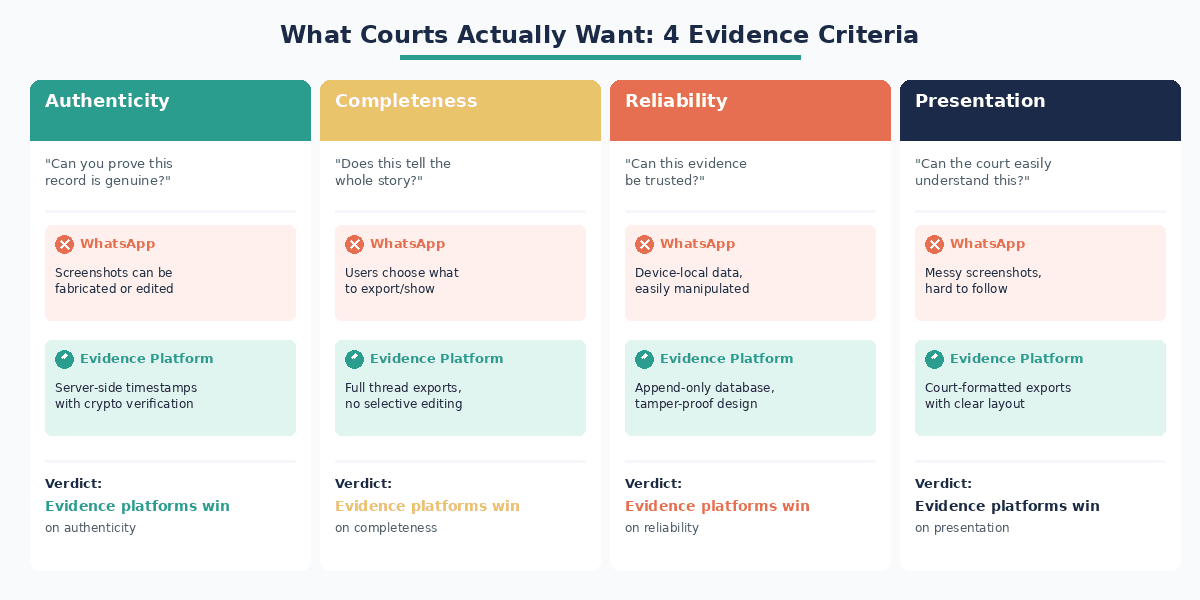
When a landlord-tenant dispute reaches a tribunal or court, judges evaluate evidence based on:
1. Authenticity
Can you prove this record is genuine?
- Who created it?
- When was it created?
- Has it been altered since creation?
- Is there independent verification?
WhatsApp screenshots fail here. You created the screenshot. You control when it was taken. There's no independent party confirming the underlying message existed.
2. Completeness
Does this tell the whole story?
Courts are suspicious of selective disclosure. If you present 5 messages but there were actually 50 in the thread, and 45 of them undermine your case, you have a problem.
With WhatsApp, you choose what to export. That choice itself becomes suspect.
3. Reliability
Can this evidence be trusted?
- Are timestamps accurate?
- Is the record-keeping system designed to prevent tampering?
- Does the platform have a track record of being used for legal evidence?
Consumer messaging apps prioritise convenience, not evidential reliability.
4. Presentation
Can the court easily understand this evidence?
WhatsApp exports are messy. Email chains are convoluted. Screenshots are hard to read. Judges don't have unlimited time to piece together what happened from fragments.
What Evidence-Grade Communication Looks Like
Purpose-built property communication platforms approach this differently. Instead of hoping casual communication can be repurposed as evidence, they design for evidence from the start.
Immutable Timestamps
Every message receives a timestamp at the moment it's processed by the server — not the user's device. This timestamp cannot be backdated or altered by either party.
Why it matters: When a tenant claims "you never told me about the inspection," you can prove exactly when the message was sent, to the second.
Append-Only Records
Once a message is sent, it cannot be edited or deleted by either party. The system only allows appending new messages, never modifying old ones.
Why it matters: Neither landlord nor tenant can clean up the record before a dispute. What was said stays said.
Cryptographic Integrity
Messages can be hashed using algorithms like SHA-256. Any modification to the content — even a single character — completely changes the hash. Export files include these hashes.
Why it matters: You can mathematically prove that the document you present in court is identical to what was originally recorded.
Complete Thread Export
Export functions produce the entire communication history, not selected messages. There's no way to cherry-pick favourable messages.
Why it matters: Courts see everything. Your evidence is credible because you can't have hidden the inconvenient parts.
Read Receipts
The system records when messages were opened and by whom. This isn't optional or dependent on user settings.
Why it matters: "I never saw that message" becomes a verifiable claim, not an uncontested assertion.
Designed for Legal Use
Export formats are optimised for court submission: clear layouts, timestamps on every entry, party identification, page numbers, document integrity verification.
Why it matters: Judges can actually read and understand your evidence without decoding screenshots.
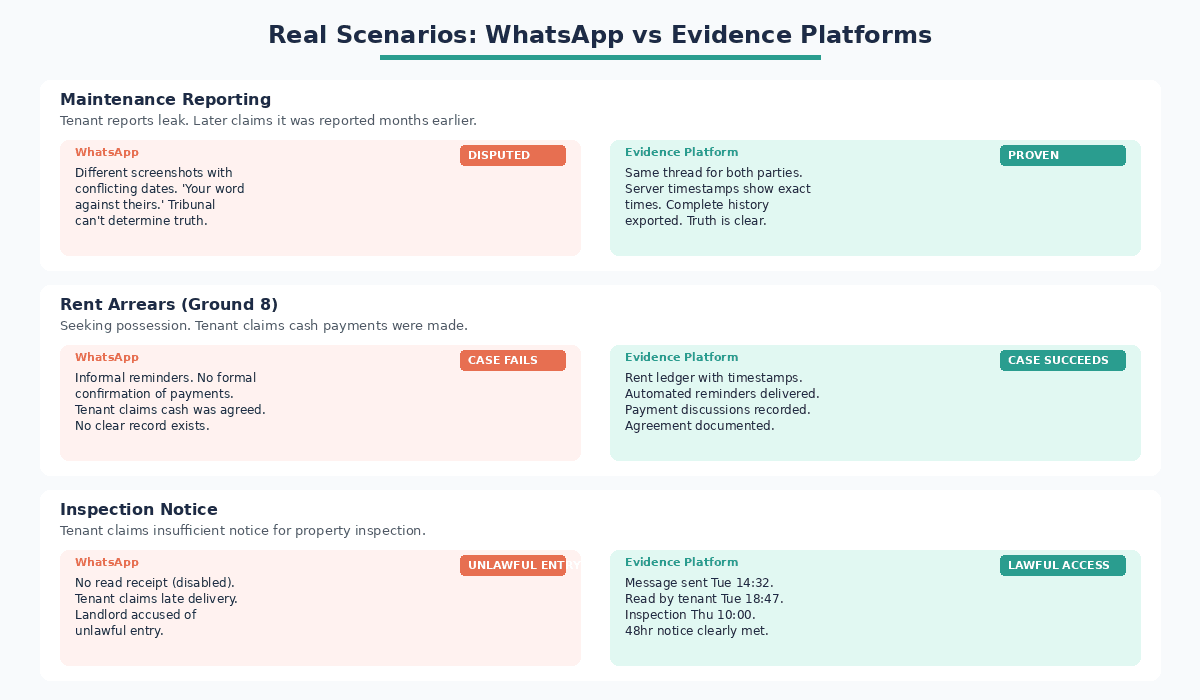
Real Scenarios: WhatsApp vs Evidence Platforms
Scenario 1: Maintenance Reporting
The situation: Tenant reports a leak. Landlord responds. Work is scheduled. Tenant later claims the leak was reported months earlier and landlord failed to act.
WhatsApp reality:
- Tenant shows screenshots of earlier messages you don't have
- Your screenshots show different dates
- It becomes "your word against theirs"
- Tribunal can't determine the truth
Evidence platform reality:
- Both parties have same thread — it's impossible for them to differ
- Server-side timestamps show exactly when each message was sent
- Export shows complete history, not selections
- Tribunal sees the actual timeline
Scenario 2: Rent Arrears
The situation: Landlord seeks possession under Ground 8. Tenant claims they made payments that weren't recorded.
WhatsApp reality:
- Informal reminders sent
- Some payments discussed but not formally confirmed
- Tenant claims they were told cash payments were fine
- No clear record of what was agreed
Evidence platform reality:
- Rent ledger with each payment timestamped
- Automated reminders with delivery confirmation
- Any payment discussions are in the permanent record
- Agreement or disagreement is documented
Scenario 3: Inspection Notice
The situation: Landlord seeks access for inspection. Tenant claims insufficient notice was given.
WhatsApp reality:
- Landlord sent message Tuesday, claiming 48 hours' notice
- Tenant claims they only saw it Thursday morning
- No read receipt (tenant has them disabled)
- Landlord entered property; tenant claims unlawful entry
Evidence platform reality:
- Message sent Tuesday 14:32
- Read by tenant Tuesday 18:47
- Inspection scheduled for Thursday 10:00
- 48-hour minimum notice clearly met
Scenario 4: Anti-Social Behaviour
The situation: Landlord seeks possession under Ground 14. Tenant denies incidents occurred.
WhatsApp reality:
- Neighbour complaints came via WhatsApp to landlord
- Landlord forwarded to tenant
- Original timestamps lost in forwarding
- Tenant claims complaints were fabricated
Evidence platform reality:
- Complaints logged with original dates
- Tenant's responses recorded
- Landlord's warnings documented
- Pattern of behaviour visible in single thread
The Awaab's Law Factor
Awaab's Law introduces mandatory response timeframes for housing hazards:
- Emergency hazards: 24 hours
- Significant damp and mould: Investigation within 14 days, repairs within 7 days after
The critical question: Can you prove when you responded?
With WhatsApp, you're relying on screenshots of your own messages. The timestamp is only as trustworthy as your device's clock settings.
With an evidence platform, server-side timestamps create an independent record. Your compliance with legal deadlines is provable.
Common Objections
"WhatsApp is free"
True. But:
- What does losing a possession case cost?
- What does a rent repayment order cost?
- What does being found in breach of Awaab's Law cost?
Free tools that create inadequate evidence are expensive in the long run.
"My tenants prefer WhatsApp"
Tenants prefer whatever is convenient — until they need evidence too. Good documentation protects both parties. A tenant wrongly accused of not reporting an issue is served by having immutable records just as much as a landlord.
Also: you don't have to abandon WhatsApp entirely. Use it for casual communication. Use an evidence platform for anything that might matter later.
"I've never had a dispute"
Yet. The average landlord will face at least one serious dispute during their time as a landlord. Rent arrears, deposit disputes, possession proceedings, disrepair claims — something will happen eventually.
The time to build good evidence habits is before you need them, not after.
"Courts accept WhatsApp messages"
Courts consider WhatsApp messages. That's not the same as trusting them. A judge will weigh WhatsApp evidence against its reliability concerns. If the other party challenges authenticity, you have a problem.
Courts prefer evidence that's harder to dispute.
"This sounds like overkill for a few rental properties"
The complexity of the dispute doesn't scale with the number of properties. One property with one difficult tenant can create just as much legal exposure as a portfolio of 50.
Making the Transition
You don't have to overhaul everything overnight. A practical approach:
1. Keep Using What Works for Casual Chat
A quick "I'll be 10 minutes late" message doesn't need evidence-grade documentation. WhatsApp is fine for the truly casual.
2. Use Evidence Platforms for Anything That Might Matter
- Maintenance reports and responses
- Rent discussions
- Inspection notices
- Any issues or complaints
- Anything involving deadlines
3. Train Your Tenants
Explain that official communication goes through the platform. Make it easy for them to use it. Free tenant access removes adoption friction.
4. Set Expectations at the Start
Include your communication platform in the tenancy agreement. Make it clear this is where issues should be reported and responses will be given.
The Bottom Line
Communication tools serve different purposes. WhatsApp is excellent for staying in touch with friends and family. It was designed for that.
Evidence platforms are designed for situations where what was said might need to be proved later. They're built with legal requirements in mind.
As a landlord operating under the Renters' Rights Act 2025, you're now in a world where evidence matters for every eviction. Every possession ground requires proof. Every Awaab's Law deadline needs documentation.
The question isn't whether you can afford an evidence platform. It's whether you can afford to operate without one.
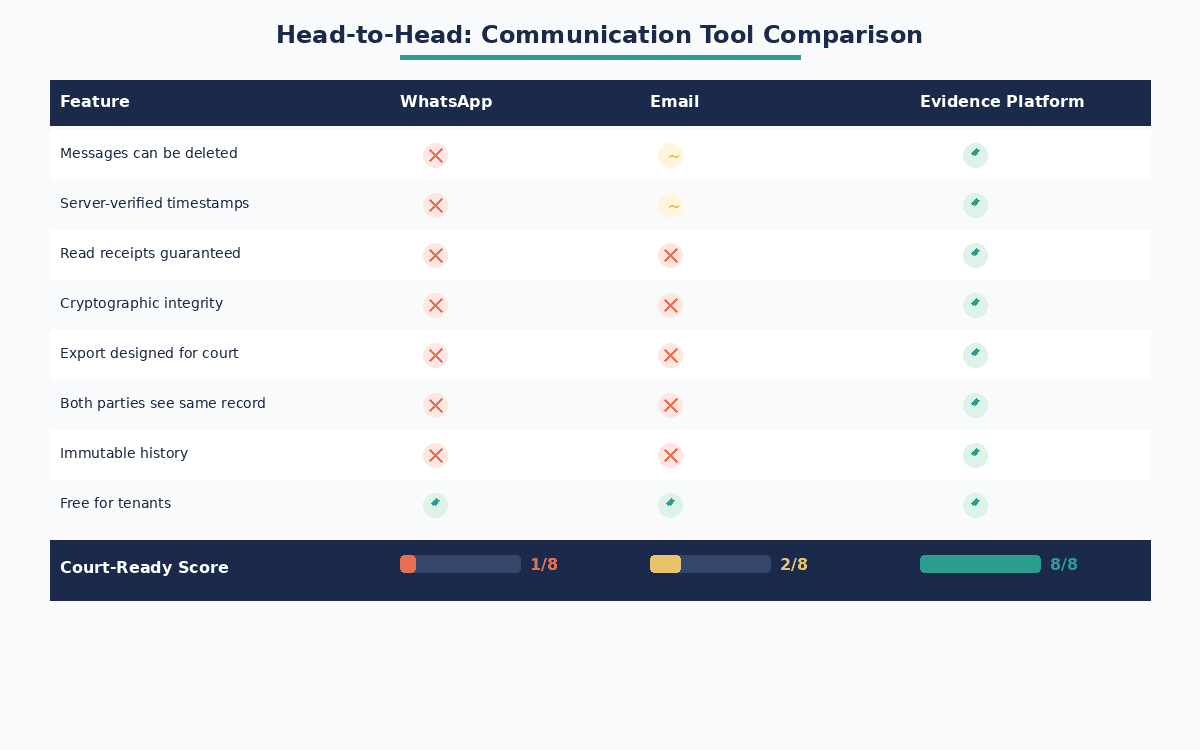
Quick Comparison
| Feature | Evidence Platform | ||
|---|---|---|---|
| Messages can be deleted | Yes | Sometimes | No |
| Timestamps verified by server | No | Partially | Yes |
| Read receipts guaranteed | No | No | Yes |
| Cryptographic integrity | No | No | Yes |
| Export designed for court | No | No | Yes |
| Both parties see same record | No | No | Yes |
| Immutable history | No | No | Yes |
| Free for tenants | Yes | Yes | Yes (good platforms) |
Frequently Asked Questions
Q: Can I use WhatsApp messages as evidence in court? A: Courts will consider WhatsApp messages, but they're easily challenged. The other party can argue messages were fabricated, edited, or selectively exported — and they'd be right that this is technically possible. Courts prefer evidence that's harder to dispute.
Q: What makes evidence "court-admissible"? A: Courts evaluate evidence on authenticity (can you prove it's genuine?), completeness (does it tell the whole story?), reliability (are timestamps accurate?), and presentation (can the court easily understand it?). WhatsApp fails on most of these criteria.
Q: Are email records better than WhatsApp? A: Slightly. Email headers contain routing information and timestamps are server-side, making them harder to manipulate. However, "I never received that email" is still a common defence, and long email chains become confusing to present.
Q: Do I need to abandon WhatsApp completely? A: No. Use WhatsApp for casual communication ("I'll be 10 minutes late"). Use an evidence platform for anything that might matter legally: maintenance reports, rent discussions, inspection notices, complaints, and anything involving deadlines like Awaab's Law timeframes.
Q: How do evidence platforms create "immutable" records? A: They use server-side timestamps (not device clocks), append-only databases (no editing or deleting), and cryptographic hashing (any change completely alters the hash). Some also provide read receipts that can't be disabled.
This comparison is for informational purposes. Evaluate any platform against your specific needs and consult your solicitor about evidence requirements for your situation.
Further Reading:
- Section 8 Evidence Requirements
- Awaab's Law Compliance Checklist
- Renters' Rights Act 2025 Landlord Guide
Sources:
- Civil Evidence Act 1995 — Admissibility of evidence in civil proceedings
- First-tier Tribunal (Property Chamber) Procedure Rules — Evidence requirements for housing disputes
- GOV.UK Guide to Renting — Landlord responsibilities and documentation
About the Author
Togal Team
Content Team
The Togal team writes about UK rental regulations, compliance best practices, and evidence-based communication for landlords and tenants.
View all posts by Togal